Hazard Communication Program
The Occupational Safety and Health Administration Hazard Communication Standard (29 CFR 1910.1200), or the “Right-to-Know” standard is intended to increase employee awareness about chemical hazards in their workplace. Employees have the right to:
- Recognize chemical hazards,
- Understand labels and other forms of warning on chemical containers,
- Know where the chemical inventory for their work area is kept,
- Ready access to Safety Data Sheets (SDSs),
- Know emergency procedures for chemical spills,
- How to reduce or prevent exposure to hazardous chemicals by using good work practices, engineering controls and personal protective equipment (PPE).
This program applies to all VCU employees who work with, are exposed to or supervise operations involving hazardous chemicals at VCU.
Research scientists and laboratory personnel who work with hazardous chemicals at laboratory scale are subject to the VCU Chemical Hygiene Plan.
Definitions
Definitions
- Chemical: Any substance or mixture of substances obtained by a chemical process or used for producing a chemical effect.
- Chemical name: The scientific designation of a chemical in accordance with the nomenclature system developed by the International Union of Pure and Applied Chemistry (IUPAC) or the Chemical Abstracts Services (CAS) rules of nomenclature, or a name that clearly identifies the chemical for the purpose of conducting a hazard assessment.
- Classification: Means to identify the relevant data regarding the hazards of a chemical; review those data to ascertain the hazards associated with the chemical; and decide whether the chemical will be classified as hazardous according to the definition of hazardous chemical in this section. In addition, classification for health and physical hazards includes the determination of the degree of hazard, where appropriate, by comparing the data with the criteria for health and physical hazards.
- Container: Any bag, barrel, bottle, box, can, cylinder, drum, reaction vessel, storage tank or the link that contains a hazardous chemical.
- Employee: A worker who may be exposed to hazardous chemicals under normal operating conditions or in foreseeable emergencies. Workers such as office workers who encounter hazardous chemicals only in non-routine, isolated instances are not included.
- Hazard class: The nature of the physical or health hazards (e.g., flammable solid, carcinogen or oral acute toxicity).
- Hazard statement: A statement assigned to a hazard class and category that describes the nature of the hazard(s) of a chemical, including, where appropriate, the degree of hazard.
- Hazardous chemical: Any chemical which is:
- Physical hazard
- health hazard
- simply asphyxiant
- combustible dust or
- pyrophoric gas
- hazard not otherwise classified
- Health hazard: A chemical which is classified as posting one of the following hazardous effects:
- Acute toxicity (any route of exposure)
- Skin corrosion or irritation
- Serious eye damage or eye irritation
- Respiratory or skin sensitization
- Germ cell mutagenicity
- Carcinogenicity
- Reproductive toxicity
- Specific target organ toxicity (single or repeated exposure) or
- aspiration hazard
- Label: An appropriate group of written, printed or graphic information elements concerning a hazardous chemical that is affixed to, printed on or attached to the immediate container of a hazardous chemical or to the outside packaging.
- Non-routine task is: An infrequent, occasional or abnormal activity where employees may encounter a hazardous chemical they do not normally handle.
- Physical hazard: A chemical that is classified as posing one of the following hazardous effects:
- Explosive;
- Flammable (gases, aerosols, liquids or solids);
- Oxidizers (liquid, solid, or gas); self-reactive;
- Pyrophoric (liquid or solid); effects: explosive;
- Flammable (gases, aerosols, liquids or solids);
- Oxidizers (liquid, solid or gas); self-reactive;
- Pyrophoric (liquid or solid);
- Self-heating;
- Organic peroxide;
- Corrosive to metal;
- Gas under pressure; or
- In contact with water emits flammable gas.
- Pictogram: A composition that may include a symbol plus other graphic elements, such as a border, background pattern or color that is intended to convey specific information about the hazards of a chemical. Examples can be found here.
- Precautionary statement: A phrase that describes recommended measures that should be taken to minimize or prevent adverse effects resulting from exposure to a hazardous chemical or improper storage or handling.
- Product identifier: The name or number used for a hazardous chemical on a label or in the Safety Data Sheet.
- Safety Data Sheet (SDS): Written or printed material concerning a hazardous chemical which is prepared in accordance with 29 CFR 1910.1200(g).
- Signal word: A word used to indicate the relative of severity hazard and alert the reader to a potential hazard on the label. The signal word used in this section are “danger” and “warning." “Danger” is used for the more severe hazards, while “warning” is used for the less severe.
- Simple asphyxiant: A substance or mixture that displaces oxygen in the ambient atmosphere, and can thus cause oxygen deprivation in those who are exposed, leading to unconsciousness and death.
- Work area: A room or defined space in the workplace where hazardous chemicals are produced or used, and where employees are present.
Responsibilities
Responsibilities
- VCU Occupational Health and Safety (OHS): OHS provides subject matter experts in Occupational Safety, Occupational Health, Industrial Hygiene, Fire & Life Safety, Biosafety, Radiation Safety, Chemical Safety, and Lab Safety. VCU OHS is responsible for:
- Performing periodic safety inspections,
- Injury and incident investigations,
- Development of general occupational safety training,
- Periodic review and maintenance of this Hazard Communication Program, and
- Providing safety consultations upon request.
- Assisting departments with informing third party contractors of chemical hazards that may be encountered while working at VCU.
- Managers/supervisors: Managers and supervisors, in collaboration with OHS, are responsible for identifying risk for work tasks performed under their supervision and implementation of safety programs, initiatives and hazard mitigations in areas under their operational control. Managers and supervisors are also responsible for ensuring all individuals under their direction have the necessary knowledge, skills, equipment and PPE to perform their work safely. This includes but is not limited to:
- Notifying all employees of the purpose and intent of the Hazard Communication Program prior to working with hazardous chemicals at their work site,
- Identifying hazardous chemicals in their work area that may pose a potential health or physical risk to their employees,
- Ensuring all affected employees complete General Hazard Communication training,
- Providing department-specific training relating to hazardous chemicals, safe work practices, procedures, location of applicable safety equipment, and proper PPE selection prior to working with hazardous chemicals,
- Maintaining a hazardous chemical inventory and updating the list on an annual basis or whenever a new chemical is used in the workplace,
- Ensuring SDS for all hazardous materials in their work area are readily available for employees,
- Ensuring that all hazardous materials are properly labeled and that these labels are not removed or defaced,
- Ensuring personal protective equipment is made available,
- Adequately informing contractors and other outside personnel sharing the same work area of the hazardous substances to which their employees may be exposed, and
- Requesting assistance from OHS as needed for safety consultation.
- Employees are responsible for:
- Exhibiting safe behaviors,
- Completing required training (general and site-specific),
- Reviewing chemical safety information on the label and/or SDS prior to using a chemical,
- Using engineering controls
- Adhering to administrative controls as required,
- Wearing PPE as required,
- Reporting injuries and incidents, and
- Providing feedback regarding observed hazardous conditions, unsafe behaviors and/or safety program improvements.
- Contractors are responsible for:
- Providing information and training relevant to OSHA Communication Standard to their employees;
- Notifying the VCU project manager during pre-construction meeting(s) if a hazardous chemical is to be used on the project which could result in exposure to university staff, students and visitors, and
- Ensuring SDSs for hazardous chemicals are accessible to VCU project manager and present at the project location.
- The VCU project manager is responsible for:
- Providing OHS with required SDSs from the contractor when the project involves the use of hazardous chemicals,
- Ensuring that the contractor submits a contingency plan for any incidental hazardous chemical spills or release, and
- Ensuring construction work involving the use of hazardous chemicals is conducted in a manner that minimizes any potential exposure to VCU employees, students, or visitors including attempting to replace hazardous materials with a less hazardous substitute.
Hierarchy of controls
Hierarchy of controls
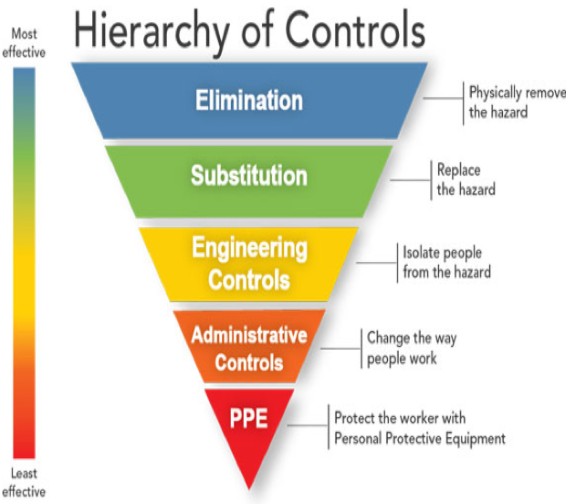
- Elimination: The best way to control a hazard is to eliminate it and remove the danger. This can be done by changing a work process in a way that will get rid of a hazard, such as purchasing equipment with updated safety devices that remove the hazard without compromising desired outcomes.
- Substitution: The second best way to control a hazard is to exchange a more hazardous chemical for a less- or non-hazardous material.
- Engineering controls: If a hazard cannot be eliminated or a safer substitute cannot be found, use engineering controls to keep the hazard from reaching the worker. This could include methods such as using local exhaust ventilation that captures and carries away the contaminants before they enter the breathing zone of workers (i.e., use of fume hoods and biosafety cabinets). Please note that ductless fume hoods are not approved to be used as a replacement for ducted fume hoods and must be approved by OHS prior to use.
- Administrative controls: If engineering controls do not mitigate all of the anticipated risk, administrative controls must be considered. Administrative controls involve provisions relating to organization and management, procedures, record keeping, assessment and reporting necessary to ensure safe operation of a facility. Administrative controls include:
- Ensuring that all personnel have received mandatory training to conduct their work safely;
- Implementing and enforcing SOPs that include safe work practices;
- Reducing time that personnel might be exposed to a specific hazard;
- Restricting access to certain areas and/or chemicals with high hazards, except for personnel with appropriate training; and
- Enforcing good housekeeping at all times.
- Personal protective equipment (PPE): PPE can control hazards by placing protective equipment directly on workers' bodies. Employees must be trained how to wear each type of PPE properly. When conducting a hazard assessment, PPE must be selected to provide adequate chemical resistance and ensure that all potential routes of exposure are protected.
- For example, if gloves are required for work with certain chemicals, the correct type of gloves must be used.
- PPE must be used in conjunction with more effective controls or if there are no other more effective ways to control the hazard.
- PPE must be provided to employees without charge.
Chemical container labeling system
Chemical container labeling system
- All primary chemical containers must be labeled.
- Product identifier used on the SDS;
- Signal word;
- Hazard statement(s);
- Pictogram(s);
- Precautionary statements; and
- Name, address, and telephone number of the chemical manufacturer, importer or other responsible party.
- Chemical manufacturers, importers and distributors are legally obligated to provide labeled products with the following information:
- Existing labels on commercial products must not be removed or defaced unless the container is immediately marked with the required information listed above.
- Secondary or "transfer" containers must be labeled if the container will not be constantly attended to, under the user’s immediate supervision, and if the chemical will not be used within one work shift.
- The name of the substance (full name or names of the chemicals in a solution with percentages)
- Date chemical was placed in the container
- All hazard warnings/pictograms, like the original container(s)
- A printable label sheet is available here.
- Secondary container labeling must include the following:
- Always label secondary storage containers. This will eliminate confusion where there are more than one unlabeled containers in use, and will ensure that container content is known in the event of an emergency where outside personnel may be involved.
- Labels for secondary containers must be a separate new label with all required information and cannot be written directly on the container.
- NOTE: Any unlabelled or unknown chemicals will not be picked up for disposal by OHS unless a cost code is provided by the department.

Safety data sheets
Safety Data Sheets (SDSs)
- Chemical manufacturers and importers must evaluate their materials to determine if they are hazardous. If the material is considered hazardous, a SDS must be prepared and sent to the purchaser for each hazardous chemical purchased.
- SDSs shall be readily accessible to all employees who handle or might be exposed to hazardous chemicals in the workplace, so that they may understand the hazards, health effects and symptoms, controls, and emergency procedures when working with a hazardous chemical.
- Each department or work area must maintain a SDS for each hazardous chemical or material in use. SDSs must be filed and maintained electronically in SciShield (BioRaft).
- The ChemTracker chemical inventory system in SciShield has the ability to link to available online SDSs for several common manufacturers and vendors,
- Hard copies may be kept onsite as long as they are readily available to all personnel during the work shift. Hard copies do not replace the requirement to maintain chemical inventory and SDSs in SciShield (BioRaft).
- More detailed information regarding SDSs is covered in:
Chemical inventory
Chemical inventory
- A current inventory of all potentially hazardous chemicals must be maintained for every chemical stored and used or produced within each work area. The chemical inventory should be updated annually, or upon the introduction of a new chemical into the work area.
- All VCU departments/groups must maintain their chemical inventories using the SciShield (BioRaft) inventory management system, ChemTracker.
- All groups must complete a chemical reconciliation of their chemical inventory at least annually. A chemical reconciliation how-to document is available from OHS upon request. If you need assistance with completing your group’s chemical inventory reconciliation, please contact OHS (dohs@vcu.edu).
Training
Training
- All employees working with or potentially exposed to hazardous chemicals must be trained on the potential hazards, acceptable controls, proper PPE selection, and safe use, and spill response for those chemicals. Both general and department-specific training must be completed before an employee’s initial assignment working with hazardous chemicals.
- General Hazard Communication Training is distributed through the SciShield (BioRaft) system and includes awareness level training on:
- The Hazard Communication Standard
- Hazardous chemicals
- Physical hazards
- Health hazards
- Labels and pictograms
- Chemical inventory and SDSs
- Labeling requirements
- Routes of exposure
- Risk minimization
- Spill response
- Department-specific training shall be conducted before initial assignment involving hazardous materials and whenever a new hazard (e.g., new class of chemical hazards, a change in assignment or a new process which may be hazardous) is introduced into an employee’s work area. Department specific training is often procedure/task focused, but must include:
- Physical and health risks associated with the chemicals used,
- Symptoms of over exposure,
- Emergency procedures, and
- Employed mitigations to perform the task safely, such as local ventilation and PPE.
- Hazardous non-routine tasks are those tasks which the employee does not normally perform and for which they have not previously been trained.
- Standard operating procedures should be written and available to employees performing "non-routine" tasks involving hazardous chemicals.
- Prior to beginning non-routine tasks involving actual or potential exposures to hazardous chemicals, employees shall be informed of the hazards present, and the steps the department/ work area is taking to reduce the hazards, including ventilation, respirators, the presence of another employee (buddy systems), and emergency procedures.
- The employee shall be given appropriate work instructions, and provided with required personal protective equipment prior to starting the task.
Recordkeeping
Recordkeeping
- All occupational safety training records are maintained on the SciShield (BioRaft) database.
- Chemical inventories are maintained on the SciShield (BioRaft) database.
- SDSs are tied to chemical inventory and available in SciShield (BioRaft).
References
References
GHS hazard symbols
GHS hazard symbols
